09 June 2009

Grilled Zucchini

For years I labored under the mistaken impression that I didn't like zucchini. I can't say for sure where this prejudice originated. If I forced at gunpoint to guess though, I'd say it was the result of a long standing disagreement I had with most, if not all, members of the squash family. This was a long standing conflict that only reached a period of truce when I stopped residing in my parents home.

This period of my life was known as The Decade Of Freedom From Vegetables And Experimentation With Scurvy. Most people call it bachelorhood. It was marked by dramatic increases in cheeseburgers and rib eyes, and a violent avoidance of most flora as a culinary option. This was an exciting period of my life that featured vitamin C deficiency and flirtation with gum disease. I don't really recommend it.

Over the last several years, as my quest to not die at an early age from nutritional deficiencies has really picked up steam, I've been reintroducing a variety of plants back into my life. I've yet to give okra another shot at the pennant, but several other previously vilified representatives of the plant world have been called up from the minor leagues. Among those was zucchini, and what I've come to realize is that zucchini is not bad, but it can be made badly. As it turns out, this is true of all food.
The following preparation was improvised for a cook out with friends several weeks ago. There were people in attendance who were not interested in eating meat, so I elected to prepare a meat free alternative. I'm a nice guy like that.

Ingredients
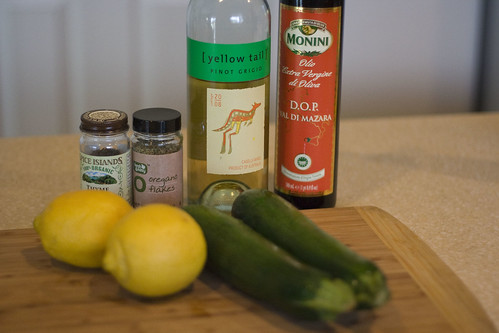
  • dried or fresh herbs (see below)
  • olive oil
  • lemons
  • white wine
  • salt
  • zucchini


Dried or fresh herbs? Man, that's a debate. I'm not going to get into it now. Just use whichever you like the most, or have available. For this particular batch I used thyme and oregano. In previous batches I used rosemary, savory, and thyme. Dill would probably be good too, but only if you liked dill. How much should you use? I'd say a tablespoon probably of each. Again, it depends on what you like, and keep in mind we're making a marinade here, not baking a cake. Is that vague enough?

User your microplane to get the zest o... What? You don't have a microplane? Go buy one. Right now. I'll wait.


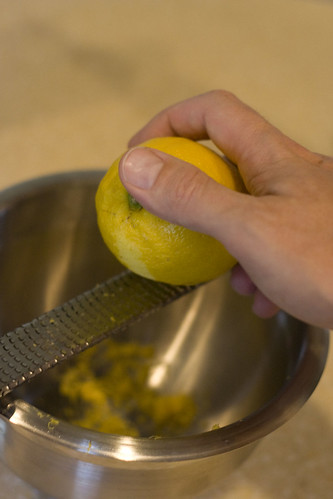
Got it? Good. Now use your microplane to remove the zest from two lemons. Wait, you still don't have a microplane? Fine, if you really must, you can carefully slice off the zest with a sharp knife or vegetable peeler. Be careful about getting too much of the pith, the white rind, it's bitter. Seriously though, get a microplane, they're awesome and versatile.

Juice both of your naked lemons and add the zest to the lemon juice in a mixing bowl. Toss in the herbs with two generous pinches of salt. Now for the wine. You'll note that I've selected a Yellow Tail Pinot Grigio. I've selected this wine because that's what was in my pantry. Feel free to use a chardonnay, riesling, or really any other white wine. My only caution here would be to avoid the old wives tale about not cooking with wine you would drink. It's silly. You want to cook with wine that tastes good, but balance that with some sense. You don't want to use a Joseph Drouhin Montrachet Marquis de Laguiche 2006 in a clam sauce. So, I tend to keep some value wines around for cooking.

Whatever wine you choose, add about 1/2 a cup to the mixing bowl. Whisk to combine, and then whisk in several healthy tablespoons of good olive oil. I'm using a Sicilian Val Di Mazara, just because that's the way I roll. Whisk everything in the mixing bowl real good. Don't kill yourself, you could mix this with a boat motor and wouldn't integrate, we haven't included anything that will work as an emulsifier, so that lemon juice and wine will never combine with the oil totally.


Wash your zucchini up, and trim off the ends, but don't peel it. We need that green skin left on to give it some structure and prevent it from falling apart when we get to the grilling. Cut the zucchini lengthwise in slices that are about 1/4 inch thick. If you cut them too thin, then they'll go all floppy when they cook and turn to mush. I'm only using two zucchini here, because there's only two people in my house. We've made enough marinade for 4-6 zucchini depending on how big they are and how thick you decide to slice them. 4 zucchini is enough to feed 8 people if this is going to be a side dish, 4 if it's an entree.


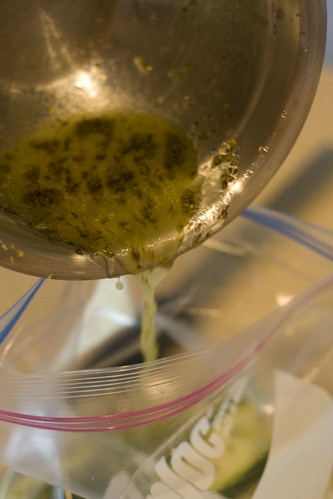
Once your zucchini is all sliced up, toss them into a gallon sized ziplock bag and then pour in your marinade. If you had to, you could do this in a glass or plastic tray or bowl, but I wouldn't recommend it. The bags are the best way to marinade anything in my opinion. If you use a bag, that's one more dish you don't have to wash. Just be sure not to use an aluminium pan for the marinading. There's a lot of acid in this marinade, and it will react with the aluminium and make everything taste funny as well as maybe ruin your pan if you leave the marinade in long enough. Once the bag is sealed, slosh everything around and try to separate the zucchini slices, they'll try their darndest to stick together.


Now's the easy part. Wait.


Just let that bag sit on the counter for a while. Anywhere from 1/2 an hour up to a few hours. I wouldn't leave it in there for much more than 2 hours though. While you're waiting, you can heat up your grill. You want those grates nice and hot to leave some pleasant looking, and tasting, grill marks. Once your grill is hot and you're done waiting on your marinade, pull the slices out of your bag with some tongs and lay them on the grill. Turn them over after a few minutes, they won't take long.


What? You don't have a grill either? Good gravy. Alright. You can do it in your broiler. After all, a broiler is just an upside down grill, right? It won't be as nice and you won't get those tasty grill marks though. Lay the slices out on in a single layer on a baking sheet and place them on the highest rack in your oven under the broiler set to high. Keep an eye on them, and in a minute or two, turn them over and repeat. Do us both a favor though, and get a grill.


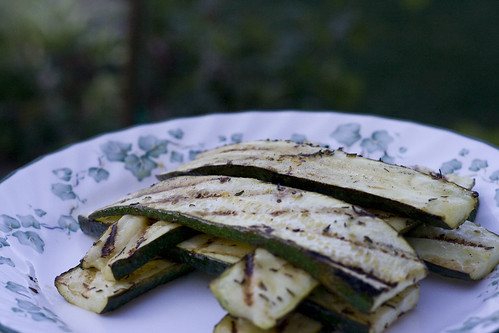
Voila! All done. These make a great side dish for a cookout. They are also a fantastic condiment for a grilled sausage or a bratwurst on a bun. Let em cool, and you can make a tasty vegetarian sandwich with them. Or, you can just take a fork and dig in.

04 January 2009

Cream of Broccoli soup

It's been nearly 2 years since I've posted anything new. That's how good this soup is.

2 tbsp Butter
1 tsp mustard powder
1 tsp + 1 pinch tarragon
1 1/4 cup yellow onion, chopped (about 1 large onion)
3 garlic cloves, minced
1 1/2 lbs broccoli, chopped, stems sliced thin
5 cups chicken broth
3 tbsp white wine
1/4 cup heavy cream
1 lime, juiced
1 pinch red pepper flakes
salt and pepper to taste
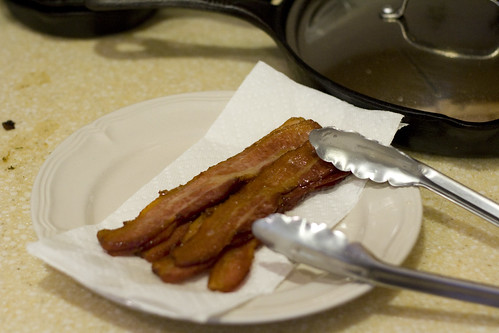
Bacon, fried and crumbled for garnish

In a stock pot, melt the butter and saute the onions and garlic until translucent. Add mustard powder and 1 tsp tarragon, stir to combine. Pour in wine and reduce by half.

Add broccoli, chicken broth and red pepper flakes to mixture. Stir to combine and when soup boils, reduce to a simmer. Cook for 15-20 minutes, stirring occasionally, until vegetables are tender and crush easily on the side of a spoon.

Using an immersion blender cream the soup until all large chunks are gone. If you don't have an immersion blender, transfer soup in batches to a blender and then return soup to the stock pot. Don't fill the blender up too far, as hot soup will expand when blended. Seriously though, just get an immersion blender.

Once blended, add in cream, lime juice and pinch of tarragon, blend to combine and add salt and pepper to taste. Serve with garnish of crumpled bacon.

Serves 6 hungry people, or 8 children.

24 January 2007

Early in the evening, just about supper time.

Winter is soup season. regardless of whether it's tomato or cream based, has beef, chicken or shrimp, starts with a mirepoix or a roux, as long as it's hot and warms the belly, it'll be appreciated. If it's made with fresh, quality ingredients, to complete a delicious and well balanced meal in a bowl, it will be desired. If you don't skip on the cream and butter, it will be coveted. Buckle up kids, this ain't diet food, but you're going to love it.

4 small yukon gold potatoes, small dice
2 leeks, white part only, diced
1 shallot, diced
3 stalks of celery, diced
1 small or 1/2 medium yellow onion, diced
3 tablespoons flour
2 teaspoon dried thyme
2 teaspoons Worcestershire sauce
1/4 teaspoon dried mustard
4 tablespoons of butter
4 tablespoons of olive oil
2 cups of chicken stock
1 1/2 cups of heavy cream
salt and pepper to taste

Add 2 tablespoons of the butter and 2 tablespoons of the olive oil to a large hot skillet. Saute the potatoes in the oil until well browned and cooked through. Remove the potatoes from the skillet and toss with salt and pepper to taste.

Try not to eat the potatoes.

Add the remaining butter and oil to the hot pan and when melted, add the onion, shallot, celery, leeks, and thyme. Saute until translucent and just barely caramelized. Mix in the flour and mustard, stirring constantly until a brown and bubbling roux forms.

Reduce the heat and slowly pour in the stock and cream, stirring constantly to blend well. Do not allow it to boil. Stir in the Worcestershire sauce and keep stirring until slightly thickened. Stir in the potatoes and season to taste with salt and pepper. Serve hot.

15 January 2007

And now, a digression about Pirates and Barbecue

The word Buccaneer presents many imaginative images. Swashbuckling heroes, desperate sea battles between ponderous ships, daring and poetic romance, even despicable and foul treachery. When you think of a buccaneer though, you likely don't imagine your father, sweating beside a Weber grill filled with too little charcoal and too much lighter fluid, wielding tongs and hot dogs like some primordial fire worshipper dressed in a denim apron emblazoned with the words, "real men cook with oxidizing exothermic chemical reactions!"


The startling, if not bewildering truth though, is that Pop, no matter how culinary challenged he may be, is closer to the real buccaneer image than any of the others i've mentioned with the potential exception of foul treachery.


The word Buccaneer, is a french word, which according to some has a literal translation as "Hunter of Wild Oxen." Not being particularly fluent in French I can not verify that, but it sounds like something they would say. In any event, Buccaneer, is the english derivative of the word boucanier which means "user of a boucan." Hardly a revealing phrase that. One wonders exactly what a boucan may be and why I just don't get to the point.


Etymology is perhaps the ultimate pursuance of pedantry. Those that revel in it also revel in the most trivial of details. For instance. It's a widely held misconception that the word barbecue is derived from the french phrase "barbe à queue" meaning "from beard to tail," a reference to cooking an entire pig whole. Despite the fact that pigs rarely sport beards this pseudo-etymology has entered the common lexicon as truth. Trust me, this is relevant.


Boucan, as we've already established, is a french word. It refers to a frame of green wood used to cook and smoke meat over open coals and is in turn derived from the Tupi word, mukem rendered in Portugese as moquem. The Tupi, for purposes of edification are an aboriginal tribe from northern brazil, but it isn't so much the Tupi we're concerned with. Boucan referred not only to the frame work that held the meat, but also to the meat itself, both on the hoof and prepared.


The word came into common usage in the late 1600s by french settlers working as hunters in the Spanish West Indies. When the Spanish outlawed the practice and drove these French hunters from their jobs, those same hunters turned to a life of crime aimed chiefly at avenging themselves against the Spanish. What reason the Spanish had for such an action is unclear, although it was likely prompted by the bitter racism and nationalism that was prevalent at the time. The French you see, were no friends of the Spanish, and the Spanish for their part felt much the same for the French.


These Boucaniers then turned into lawless bandits, and around the same time the word was anglicized into Buccaneer it came to be used by the English to describe a pirate of any nationality that made war chiefly against the Spanish. It wasn't long before the term was used to describe practically any pirate or seemingly piratical behavior.


The French, for their part, continued to use the root word boucan to refer to smoke cured meat, open fire cooking and the framework of wood used in said cooking. They even used the word to refer to similar frameworks of wood used as elevated bedding by many inhabitants of the West Indies to avoid nighttime visits from serpents, much in the same way that the Tupi used the word mukem.


"What," you may ask, "has any of this to do with my father and his incapacity to cook hot-dogs to an even temperature over his poorly crafted fire?" I'm glad you asked. The French word boucan derived from the Tupi word mukem. On the Spanish held island of Hispaniola the aboriginal tribe Arawakan called the same framework of wood and the meat it was used to cook as barbacoa in their language, Taino. Hispaniola, part of which is now known as Haiti, was much contented among the european nations and indeed has remained divided politically into the 21st century. This cultural and linguistic mishmash brought the terms boucan and barbacoa into more or less synonymous use for the cooking of meat over open pits of coals. Barbacoa is the word from which the now chiefly, although hardly exclusive, American practice of barbecue finds its origins.


So, you see, your father, in his comical apron and using his inefficient, although flavor enhancing fuel is no mere backyard cooker, he epitomizes the swashbuckling buccaneer.

13 November 2006

La Caja China; Part One

When Jose´ told me about his pig box, I listened politely and nodded approvingly in all the right places. I mentioned how I was quite fond of the pork beast and all it's many delicious pieces. Men talk about meat. Like cars, sports and pointless explosions, meat is something that men have an opinion about and we never really shy away from sharing those opinions. It's like a secret language for us, one that we use to communicate at an instinctual level.


What Jose´ was really saying was "I like pork. I want to share some with you some day, so that you can tell me how good my pork is." I accepted his offer and offered to reciprocate by telling him about my smoked tri-tip and the special seasoning blend that I use for dry rubs.

Then, like many men, I completely forgot the entire exchange; until next Christmas. I was returning from a Christmas party when I turned the corner onto my street and my nostrils were filled with the succulent aroma or roasting pig. It filled the street and filtered in through the ventilation system of the car. If I had been a cartoon character, tendrils of wispy smoke would have gently caressed my face and lifted me by my nose to lead me to the source of the smell on my tip toes.

What I found was Jose´ and about 25 other Cubans standing in his garage huddled around a wooden box on wheels. Jose´ gestured madly and insisted that I join him. What I learned that night was that Cubans traditionally roast a pig at Christmas, that the pig is delicious, and that you don't need to speak a lot of Spanish to make someone understand that yes, you'd love another piece of crispy skin.

It was then that Jose´ told me about La Caja China, the Chinese Box. "First," he said, "you rub the pig with the sauce. You love it, you caress it like a woman, but not like your wife. Then you stab it! You stab it! Then you rub with the spice, THEN STAB IT!." His exclamations were partnered with drunken stabbing as he mimicked maiming the porcine target of his affection. "Then you put it in caja china and add the fire to the top."

"And then?" I asked.

Jose´ shrugged as if my question was irrelevant or the answer a mystery of such high order that mortals simply couldn't comprehend it. "You take out the pig." After his animated description of the preparation, I was expecting a little more in the way of details. When I pressed him for things like temperature, cooking time, and fuel, he just shrugged again. "You put the pig in, and then put the fire on and then three hours later, you take the pig out."


"Three hours?" It seemed like a rather short time to cook an entire pig.

"Yes. Always three hours." And that was that. He later explained to me that the box was magic, and that's why they called it La Caja China. According to Jose´ the Cubans have a tendency to label devices and things they don't understand, or that appear to have nearly mystical capabilities, to the Chinese. He didn't know why.

I recently got my own Caja China, and it does seem nearly magical. After a knuckle busting assembly I can assure you that the box is nothing more than a pine plywood box that's lined with sheets of stainless steel. The meat is captured in a rack and sits in the box in a drip tray. A top is placed on the box, and a grate on top of that. Coals are piled on top of the grate and lit. The coals are refreshed three times in three hours. In the last half hour the rack is flipped so the meat is skin side up to let it get crispy, but that's the only time you do anything other than watch the fire and drink a refreshing beverage.


After three hours of cooking, anything you put in there is done. The model I got can do up a 70lb pig, 4 pork shoulders, 4-6 turkeys, 12-18 chickens, 12 racks of ribs, 4 briskets, or any other suitably enormous quantity of meat. I got mine last week, and naturally I've decided to cook an entire pig for Thanksgiving.

Only a fool rushes in without experimenting though, and I wasn't about to just willy nilly try this new technique without practicing it at least once. So a friend and I prepared two picnic cuts a piece with different seasonings and marinades. The meat was secured, fire added, and time passed. Two and a half hours later, we jumped the gun and removed the coals and the pork.


The results were exceptionally tasty, although the simpler seasonings were the most favored amongst testers. Because the meat was pulled too soon, it wasn't as tender as it could have been, even though the meat had reached temperature quite quickly and stayed at temperature for more than an hour. Lessons were learned, and in a future installment, I shall detail those lessons.

18 September 2006

Lemon Pepper Chicken with balsamic vinegar glaze

2-4 chicken breasts
Juice of 1 lemon
1 tablespoon honey
1 tablespoon balsamic vinegar
1 tablespoon olive oil
1 tablespoon butter
Lemon pepper
Kosher salt

Pat chicken breasts dry and sprinkle with salt and lemon pepper. Turn oven broiler on high.

In a hot, oven safe skillet, melt butter in olive oil. Fry chicken for 2-3 minutes on each side, until browned.

Spoon or brush half of vinegar over chicken and place skillet on middle rack of oven for 3 minutes.

Remove chicken from oven. Spoon honey over chicken. Ladle remainder of vinegar over chicken. Add lemon juice to skillet.

Place skillet back in oven on top rack, directly beneath burner, for 3 minutes.

Remove chicken from skillet and serve immediately. Do not spoon sauce from pan over chicken.

11 July 2006

Don't hate the tater, hate the game

Potatoes are the most widely grown tuber in the world, and a staple of the American diet. Here's a fun fact; Potatoes do not come from Ireland. Potatoes are a new world vegetable that originate in the Andes highlands of Peru. It was imported into Spain and then slowly spread across Europe where they were considered unhealthy.

Despite being a new world vegetable, the potato has a long and varied role as a culinary ingredient. If you're american though, you've very likely only eaten in a small number of ways. Baked potato, mashed potatoes, french fries, potato chips. While fine in their own right, these three dishes don't offer the diversity of flavor that most of us crave. The more adventurous or ethnically diverse may have sampled other common potato dishes. Potato pancakes, gnocchi, or pommes souffle

Fortunately, potatoes are a hardy and durable ingredient that take well to a variety of seasonings, both sweet and savory, and cooking methods. Potatoes are almost perfect for experimentation. Fry, boil, bake, roast and grill to your hearts content.

The following recipe is my latest experimentation. I'm pleased to say that it came out quite well. The end result had the desirable crunchy exterior of an au gratin and the creamy cheesy center typical of scalloped potatoes. It came out a little sweeter than I had expected, but not enough to overbalance the savory flavors of the cheese and onion.

  • 3 russet potatoes cut into 1" cubes
  • 1 Sweet yellow onion roughly diced
  • 2 golden delicious apples cut into 1" cubes
  • 1/3 cup of Gulden's brown mustard
  • 2/3 cup of sour cream
  • 1 cup of shredded parmesan cheese
  • 1 cup of Sargento's shredded four cheese Mexican blend
  • salt and pepper to taste
In a large mixing bowl mix together the sour cream, Gulden's mustard, Sargento's cheese and half of the parmesan cheese until well blended. Salt and pepper to taste. Add the potatoes, onion, and apples, and toss until well coated.

Place mixture in a 1.5 quart baking dish and sprinkle the top with the remainder of parmesan cheese and fresh ground black pepper. Bake in a 375° oven for 1 hour. Let the dish cool for 3-5 minutes before serving.

Fun, although untested, additions would be; bacon, prosciutto, rosemary, jicama, spinach, artichoke hearts, tomatoes, and flaked smoked salmon.